admin
admin
1.0 Introduction
In this review, we conducted the financial analysis and financial projection of Hornby Plc for the year ended 31 March 2018 and did a comparison with prior year’s financial statements (i.e. 2017 and 2016) and the financial statements of one of its competitors, Lego plc.
We started by carrying out a detailed review of the traditional toy industry, and we identify that the industry generates a revenue of $87 billion in 2018 with the possibility $120 by the year 2021. The industry is also experiencing significant disruption as children are starting to embrace online digital gaming than traditional toys. Following this, we reviewed the company’s history and management strategic decision, the revenue generated and the factors militating against the company’s performance vis-à-vis the competitors.
Also, we conducted a financial analysis of the company’s statement of profit or loss and statement of financial position using vertical analysis, horizontal analysis, trend analysis and ratio analysis. We also review the impact of each financial statement areas on the performance and strategic decisions of the company.
Based on the financial analysis conducted, publicly available data and our professional judgements and assumptions, we carried out a five-year financial projection of the income statement commencing from 2019 to 2023. All assumptions and basis of assumptions were properly documented in the report, and additional information was provided in the Appendices. Based on the above, we dedicated a section to addressing our observations, their implication and recommendations thereon. We hope that the management of Hornby Plc will review this report and implement the recommendations as soon as possible.
Finally, we wish to emphasise that we have carried out this exercise based on information sourced from the public domain and from the published financial statements and no direct communication was made with any of the company’s management or representative. Also, reasonable professional judgement was exercised particularly in arriving at the five-year financial projection for the company. Hence, discretion should be carried out before relying upon this work for final investment or financial decision.
2. Industry Background
Toys are entertaining materials that diversify children’s play, as well as game materials which regulate children’s mental, physical and psychosocial development (Özyürek and Erzurumluoğlu, 2016: 14). Globally, the traditional toy market faces several external influences ranging from rapid ageing society (currently being experienced in Japan, Portugal, Germany, Italy, France, China etc.) to a fast decline in the number of children which is occasioned by low fertility and willful passivity to childbearing. The net effect is a demographic storm that will imperil and cripple economic if not mitigated. In China, the one-child policy also contributes to the gloomy business climate for toy manufacturers (although this legislation has now been relaxed). New ICT products have become a close substitute for traditional toys, and this constitutes a significant challenge to conventional toy manufacturers. Virtual reality and 3-D video games are becoming increasingly popular and attracting the attention of children and adults alike. Against the backdrops, the children toys industry has remained resilient in the face of heavy blows. There were many success stories in 2018, from the uprise in collectables to certain tech-driven toys through a raft of much-needed acquisitions and consolidations which will make the toy industry stronger (Steve Reece, 2019).
According to Statista, the global toy industry is a billion-dollar industry dominated by five leading players: Mattel, Namco Bandai, Lego, Hasbro and Jakks Pacific. Danish company Lego, known for its interlocking plastic bricks, was the industry leader with the highest revenue, 5.49 billion. As the Research and Market group published on 11 October 2018, the leading manufacturers are leveraging advanced technologies to refine their unique value proposition and gain a larger global market share (Research and Marketing, 2018).
The CEO of Lego disclosed that 2018 was a defining year for the toy industry. Disruption in retail channels and increasing digitalisation reshaped the landscape and set a course of unprecedented change. According to The NPD Group, the leading provider of toys point-of-sale market research data, the US toy market contracted 2 percent in 2018 (from $89 billion in 2017 to $87 billion in 2018 from across the 13 global markets G13), reflecting a challenging retail environment driven by the Toys”R”Us bankruptcy, softening consumer sentiments in the fourth quarter, competition from video games, among other factors. The UK and European toy markets were impacted by similar factors, while several Latin American toy markets encountered macroeconomic challenges. In spite of the 2018 revenue decline, there are indications of bright light at the end of the tunnel for toy manufacturers. For instance, the Buyers Reporter said that global toys market is projected to reach revenues of more than $120 billion by 2023, and this expected growth will be fueled mainly by the parent’s propensity to purchasing toys that improve the mental and cognitive development of children.
The UK toy market is bedeviled by many uncertainties which are hurting the industry. From Brexit to fake toys coming in from the Asia-Pacific region, the industry is struggling to forge ahead and find a secure footing at the moment. Although the trend for the past decade has been positive, from 2015 to 2018, there have been segments which have managed to perform (Brandon G., 2018). As seen in the below graphical presentation, the UK toy market is ranked lowest with a negative market growth of 8%, coming behind France, 0%, Netherlands, 1% and, Belgium, 3%. However, the overall global market growth for 2018 is put on the average of positive 4.8%, and this is expected to grow further into 2021.

3.0 Description of the company
Hornby Railways was founded in Britain by Frank Hornby in 1901 when he first received a patent for his Meccano construction toy. Hornby Plc is a holding company publicly listed on the UK stock exchange. The Company is engaged in developing, designing, sourcing and distribution of hobby and interactive products. The products are distributed online through a network of specialists and various retailers throughout the United Kingdom and overseas. The Company has operations in the United Kingdom, the United States, Spain, Italy and the rest of Europe and offers its products under different brands, such as Hornby, Scalextric, Airfix, Humbrol and Corgi. Its subsidiary, Hornby Hobbies Limited, offers products under multiple categories, which include Train Sets, Locomotives, Train Packs, Tracks and Extras, Wagons and Coaches, and Spares and Accessories. Other subsidiaries include Hornby Espana S.A., which is engaged in the development, design, sourcing and distribution of models, and Hornby America Inc., Hornby Italia, Hornby France S.A.S and Hornby Deutschland GmbH, which are distributors of models.
In 2018, Web 365 New, an online blog, reported that Hornby shares in 2015 were changing hands for over £1 but several torrid years punctuated by profit declines, cash calls and leadership changes have had a dramatic effect on the company’s value. Things got so bad in 2016 that the former Top Gear presenter James May intervened, urging Britons to “buy a train set today” in an attempt to shore up the troubled company’s finances (Web365 News, 2018).
In September, it was announced that Steve Cooke would step down as CEO, and shortly after this, Lyndon Davies, a highly experienced model and hobby professional, join the Group as CEO. Lyndon also brought with him Simon Kohler and Tim Mulhall as operational consultants who is a highly respected industry veteran in the model and hobby industry, having spent 35 years with Hornby, and Tim Mulhall specialises in building routes to market and strategic sales development.
The most significant risk exposure of the company is the risk of fluctuations in exchange rates, and this could hurt the Group’s future results. Also, the negative impact on Sterling of Brexit and the continuing uncertainties will make the US Dollar purchase of its goods more expensive
4.0 Financial Information
4.1 Financial result for 2016, 2017 and 2018
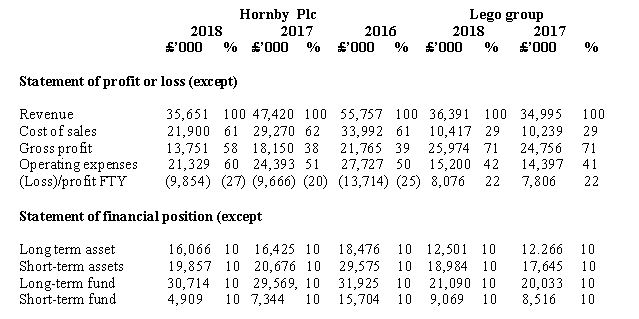
To analyse the company’s financial performance and position, we obtained the audited financial statements for 2016, 2017 and 2018 and conducted trend analysis to know whether or not the company is on a performance trajectory. The statement of profit or loss and statement of financial position along with the comparative figures, competitor’s figure (Lego group) and details of changes thereon are as stated below:
4.2 Financial review
4.2.1 Revenue
Over 80% of the company’s revenue is generated from the UK market while the remaining 20% come is from Europe and America. The company’s revenue has been on a constant decline since 2016 with a 15% decrease (equivalent to £8,337) between 2016 and 2017 and 11% decrease (equivalent to £11,769) between 2017 and 2018. This reduction in revenue could be as a result of the management decision to remove the discounting sale strategy. However, we realised that Lego revenue increased slightly by 4% with a relatively stable cost of sale. The decrease in the sale is probably as a result of the discounting sales strategy which was removed during the year to maintain the esteem value of the company’s products.
4.2.2 Cost of sales
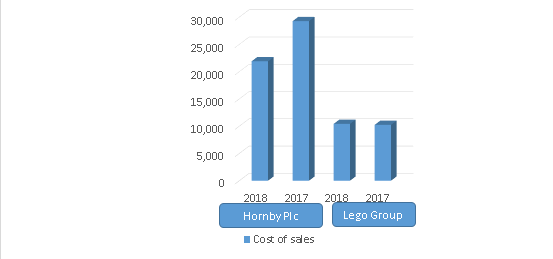
The cost of sale is the function of a company’s revenue. For Hornby Plc, the current year cost of sales represents 62% of revenue in 2018 as against 61% in 2017. Cost sales also decreased by 25% or £11 million in absolute terms from £47 million in 2017 to £35 million in 2018. However, for the Lego group, the current year cost of sales represents 29% of revenue in 2018 and 2017. The company cost of sales decreased as compared to the prior period and the Lego group because, during the year, it removed the discounting marketing strategy.
4.2.3 Operating expenses
Operating expenses decreased by 12% from 2016 to 2017 and went down further in 2018 by 13%. This decrease is probably as a result of the company aggressive cost management strategy (See Appendix A). The company appear to be doing more with less and instilling a culture of frugality which means it is on a part to profitability. The major items that contributed to the decrease are as follows:


4.2.4 Loss for the year
Net loss is the difference between gross profit and total expenses. The net operating profit margin will vary from industry to industry, and it is not something that can be directly managed. It is the outcome of the quality of the management of the factors that result in the net profit percentage and the efficiency and effectiveness of control of the business processes that are reflected in the various expense ratios. It is worthy of note that despite the decrease in operating expenses, the company continues to record losses. The gross margin is still unable to cover the total operating costs, and this is why there is no return on capital for distribution to the company’s shareholders. This is mainly because the company is unable to generate sufficient revenue to cover the total expenditure.
4.3 Analysis of the statement of financial position
We observed that the company invest more in short-term assets than does for long term assets. This is an indication that it is more of a distribution and retailing business than manufacturing. Property, plant and equipment decreased by 21% from 2016 to 2017 and further deep by the same rate from 2017 to 2018 (See Appendix A). In the same vein, Intangible assets decreased by 12% from 2016 to 2017 and by 21% from 2017 to 2018 (See Appendix A). The company is no longer involved in active manufacturing but now partners with manufacturers in Asia, however maintaining its control over product designing.
From our review of the company’s financing strategy, we observed that the company’s finances its short term assets with long term fund. The long term fund, composed of the shareholder’s fund and long term borrowing and this represents more than four times the short term funds in the three years under review (See Appendix A). This is a good financing strategy because long-term borrowing comes with a lower borrowing costs and the short term asset (such as inventory) would have been realized multiple times before repayment is made to providers of the fund.
4.4 Ration analysis
4.4.1 Working capital
Working capital, otherwise referred to as net current assets, is the excess of current assets over current liabilities. The efficient management of working capital by the Company is essential for both liquidity and profitability. Poor management of working capital means that funds are unnecessarily tied down in idle assets hence reducing the ability to invest in productive assets such as plant and machinery, thus affecting profitability. The most widely used working capital ratios are the current ratio and quick ratio
- Current ratio
The current ratio indicates the Company’s ability to settle its short term obligations without having to resort to borrowing. The Company’s current ratio was 4.0:1 in 2018 as against 2.8:1 in 2017. The current ratio of 4.0:1 indicates that the Company will quickly meet its short term obligations as and when they fall due. The rule of thumb for the current ratio is usually given as 2:1. Anything lower than this ratio indicates poor liquidity. The company is in a better liquidity position compared with its competitor, Lego group, which has a current ratio of 2.1:1 in both 2017 and 2018. (See Appendix B).
- Quick ratio
The quick ratio indicates the Company’s ability to meet its short term obligations out of its liquid assets which are those assets that can be readily converted to cash. The Company has a quick ratio of 2.0:1 in 2018 as against 1.5:1 in 2017. A quick ratio of 2.0:1 indicates that the Company would quickly meet up with its short term obligations out of its liquid assets. The rule of thumb for quick ratio is 1:1. Again, this indicates that the company is in a better liquidity position compared with its competitor, Lego group, which has a current ratio of 2.0:1 in both 2017 and 2018 (See Appendix B)
4.4.2 Profitability
- Gross profit percentage
The Gross profit is the profit a company makes after deducting the direct cost of manufacturing or buying the products, or the direct costs associated with providing services. The company’s gross profit percentage increased by an insignificant 1% from 38% in 2017 to 39% in 2018. The increase in revenue is as a result of the decrease in the cost of sales occasioned by the cancellation of discounting marketing strategy. This result is not encouraging because taking a glance at the gross profit of Lego group plc revealed a gross profit margin of 71% in both 2017 and 2018 (See Appendix B).
- Net loss percentage
Net loss percentage shows that for every £1 sales a loss of 0.28 pence was made in the current year as against a loss of 0.20 pence in 2017. However, when compared with the Lego group plc, for every £1 sales a profit of 0.20 pence was made in the current year and 2017.
- Return on capital employed
In addition to a healthy free cash flow surplus, companies normally exist to create sustainable and real economic value to their shareholders by investing its capital and earning rates of return that exceed risk-free rates in real terms. Assets and investments so acquired are put to productive use by management to maximise revenue and profit for shareholders. Return on net assets is a measure of how effectively management has fulfilled this responsibility. Return on capital was a negative 66% in 2018 as against a negative 69% in 2017. Whereas, Lego group plc recorded a positive return on capital employed by 50% in both 2017 and 2018 respectively; this implies that shareholders’ funds were not effectively utilised in the years under consideration.
4.4.3 Gearing ratio
Gearing ratio measures the proportion of a company’s borrowed funds to its equity. The ratio indicates the financial risk to which a business is subjected since excessive debt can lead to financial difficulties. The company’s recorded a zero per cent gearing in both current and prior year and this shows close similarity to Lego group plc. The company gearing ratio decreased because of in December 2017 because it placed an offer of 40,677,968 new ordinary shares at 29.5 pence each, raising $11.5 million net of cost. The fund raised was used to pay off the debt of £7.4 million. Hence, since December 2017, the Company has operated without needing to utilise its new Barclays Bank facility, which has a limit of £6 million.
The above financial analysis reveals that the company is managing to remain afloat over the troubled water of the model train industry. However, the most significant contributing factor to low profitability is the insufficient revenue that translated into the loss being recorded since 2017. The company should consider aggressive marketing, introduction of new technology and diversification into other product markets.
5.0 Financial Projection
In the previous sections, we carried out a holistic review of the Toy industry on the global and local level, the current trend that affects the market and the responses of principal players in the industry. We also reviewed Hornby Plc vision and mission, key management decisions in response to market trends. Finally, we examined the performance and position of the company using trend analysis of the income statement and statement of financial position and reinforced it with the computation and interpretation of relevant financial ratios.
In this section, we leveraged the information garnered so far to prepare a forecast income statement up to 2023. The projection was performed based on existing market facts, both globally and locally, and management strategic decisions to drive up sales and maintain increasing profitability. We will present the forecast and subsequently give details of assumptions and parameters that informed our conclusion.
Assumptions used for preparing the five years financial projection
5.1 Revenue
Consolidated revenue for the year ended 31 March 2018 was £35.7 million with a negative growth rate of 8 per cent, whereas, the average market growth rate is 4.5 per cent. Nevertheless, based on current management strategy and global industry prospects revenue of 120 billion dollars in 2023, we envisage that the company’s revenue will grow by 1 per cent in 2019 and by 1.5 per cent in the subsequent four years. This conclusion is reached because of the current management decision to reverse the previous management team closure of all the European market to reduce stock line. Also, as the company used part of the fund raised from share offer to settle all indebtedness, it now has borrowing capacity for expansion and would be able to negotiate favourable credit terms with the creditors. We do not envisage any material impact of Brexit on the company’s future revenue generation potential as over 80% of the company’s sales occurs outside the European Union.
5.2 Cost of sales
The Cost of sale for the year ended 31 March 2018 was £21.9 million representing 61 per cent of the revenue generated in the same year. The cost of sale is a function of the revenue generated, and the proportion of cost of sales to revenue dropped by 1% from last year. Even though the company possibly embarked on a cost management strategy by cancelling the discounting marketing strategy, we are of the opinion that there will not be any material decrease in the cost of sales proportion to revenue. Hence, cost of sales will reduce to 59% of revenue in 2019 and thereafter normalise at 57%
5.3 Operating expenses
Operating expenses reduced in the current year by 11% from £24.0 million in 2017 to £21.3 million in 2018 as a result of measures taken post-October 2017 when the senior management and the Board were restructured. The company’s operating expenses in 2018 is 60% of gross revenue, and this is relatively high when compared to Lego group operating expenses of 30%. However, due to the company’s management aggressive cost management strategy, we expect the operating expenses to fall significantly to 58% of revenue in 2019 and 55% thereafter.
5.4 Exceptional costs
The current year’s exceptional costs totaling £2.3 million (against £3.3 million in 2017) include £1.8 million relating to the restructuring of the UK business and Board changes, £0.4 million costs associated with the EGM (Extraordinary General Meeting) and mandatory offer and costs relating to the 2017 equity issue and bank refinancing (£0.1 million). I expect this cost to reduce by 50% in 2019 and then continue gently by 3% annually up to 2023. The reduction is because some of these expenses are one-off and are not expected to be repeated in 2019. For example, the cost of restructuring and cost of raising equity finance.
6.0 Observations and Recommendations
| NO. | OBSERVATIONS | PRIORITY | IMPLICATIONS | RECOMMENDATIONS |
| 6.1 | Low gross margin | |||
| The cost of sales is of about 60% of revenue is considered to be huge compared to competitors’ of just about 30% | Significant Improvement Needed | The implication of mismatch of cost of sales and revenue generation is that there will be a little available to cover indirect expenses and this will lead no negative return on capital employed. The company management may also have difficulty in raising required finance for expansion. | The company should improve its online sales strategy and employ digital technology such as Artificial Intelligence to facilitate sales. The company should consider other strategies such as toy leasing to drive up revenue. The company should improve its presence in developing and emerging economies. The company should research how competitors can generate almost equal revenue with less direct expenses. | |
| 6.2 | High operating expense | |||
| The most significant factor responsible for the company’s low performance over the years is the extremely high indirect cost that hovers between 60% and 65% | Significant Improvement Needed | High operating expenses have a negative consequence on return on capital employed. If the business is not profitable, it may be difficult to raise further fund required to finance expansion. | The company should consider outsourcing some non-core aspect of the business such as the Finance and accounting services, IT services, Legal services etc. Process review and restructuring should also be carried out to recognise what process or department constitute waste and this should be either strengthened or eliminated. The company should review its property, plant and equipment and intangible assets to identify those that are not contributing to effectively to the business and dispose of them. This action would reduce the amount charged to profit or loss as depreciation, amortisation and impairment cost. | |
| 6.3 | Apathy towards opportunity presented by online gaming platforms | |||
| Digitization is gradually shifting children’s desire from traditional toys to online games, and this prospect has been recognised by leading competitors such as Lego, Hasbro etc. | Significant Improvement Needed | The company and its products may be regarded as too orthodox and apathetic to current trends; hence, this may lead to loss of loyal customers. | The company should increase its budget towards research and development of online gaming platforms as this will improve profitability and generate more returns to shareholders. |
7.0. Conclusion
We have carried out the financial analysis of Hornby plc financial statements and the five years financial projection from 2019 to 2013 for company as at the year ended 31 March 2018. Our review shows that the company is experiencing enormous financial challenges in that it is unable to generate sufficient gross profit to cover its operational and financial expenses and then leave some return for shareholders. However, as indicated in the previous sections of this report, the company has great prospects in returning to profitability, especially with the low gearing which allow it to raise more finance for expansion and positive management decisions such as cancellation of discounting marketing strategy.