admin
admin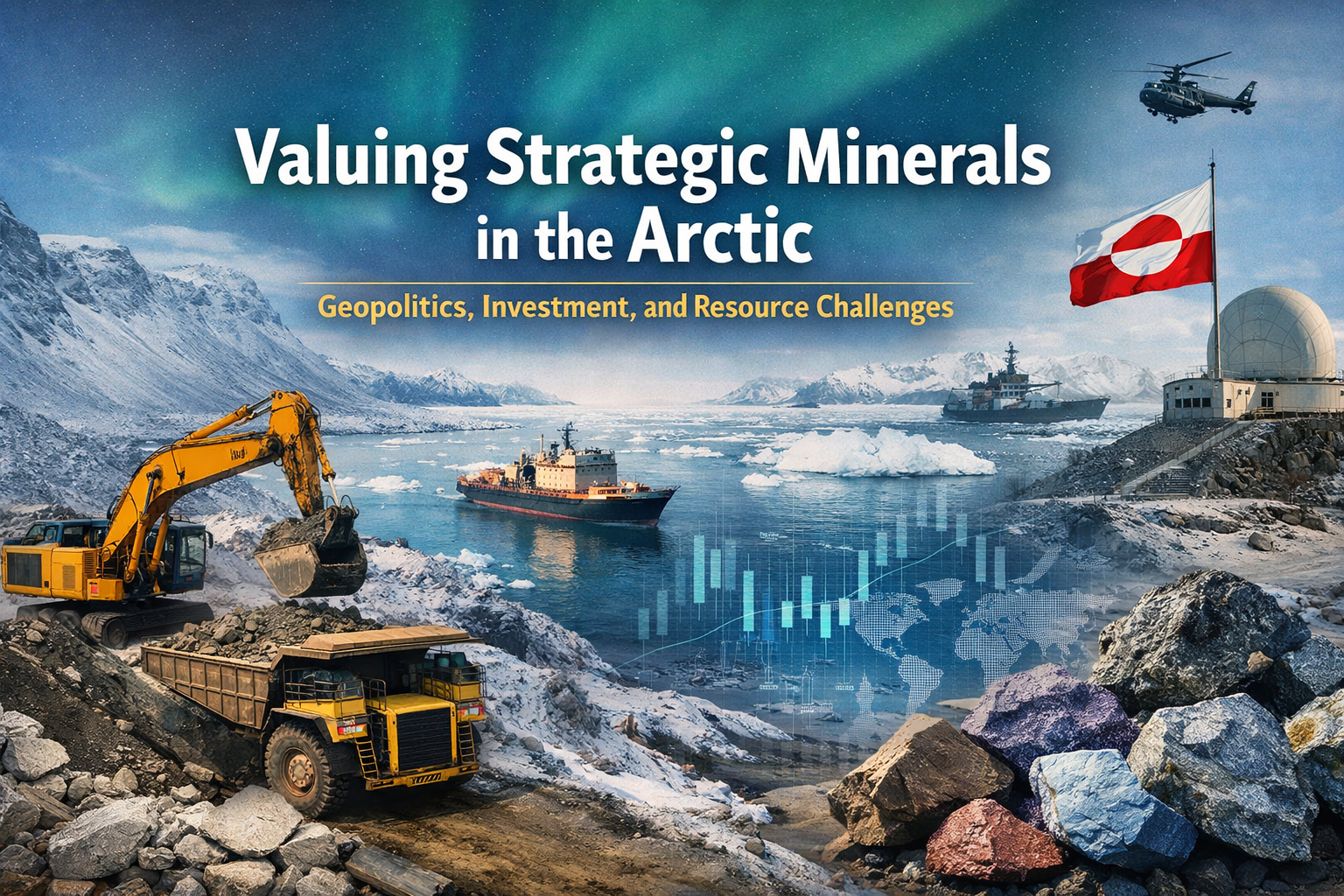
We have seen in recent news that Greenland has become a focal point for global debates about security, competition for strategic minerals, climate change, and new shipping routes. While headlines often highlight sovereignty debates and military interest, for dealmakers and investors, Greenland is less a territorial question and more a live case study in how geopolitics reshapes the valuation of strategic mineral assets. The Arctic illustrates broader challenges for valuing frontier mineral projects worldwide.
Strategic mineral assets differ fundamentally from conventional mining projects. Cash flows are heavily back-ended, with long pre-revenue phases driven by exploration, feasibility studies, environmental and social impact assessments, permitting, infrastructure build-out, and complex processing requirements. According to Goldman Sachs (https://bit.ly/45e6bIo), “in Canada it can take between five and 25 years to develop new mines, prompting the government to streamline permitting under its $3 billion critical minerals strategy and work more closely with Indigenous communities.” In my experience building financial and valuation models for conventional projects, cash flow generation is typically near-term, in the first five years. However, in many cases of strategic mining, meaningful cash generation may not occur for a decade or more. This makes traditional DCF models highly sensitive to assumptions about timing, capital intensity, and execution risk.
Terminal value estimation is particularly exposed. For valuation of conventional projects or businesses, we typically adopt a long-term inflation rate as the growth rate to perpetuity, which implicitly assumes regulatory continuity, sovereign stability, and uninterrupted operability. These conditions are rarely met in geopolitically sensitive circumstances, such as valuing Arctic assets. Terminal value should therefore be treated as conditional, with multiple scenarios reflecting policy alignment, reserve exhaustion, alliance stability, and the risk that assets are strategically constrained rather than fully monetized. In situations like this, valuation professionals might find it helpful to go beyond the usual perpetuity growth method and incorporate a real-options approach, which can make their estimates more robust and defensible.
Discount rates also require careful reconsideration. Country risk premiums or default spreads (often taken from Damodaran and other platforms) help measure downside geopolitical risk. However, they don’t always reflect the upside potential, such as changes in alliances, supportive policies, export rules, or state-backed offtake deals. Therefore, best practice should embed the effects of geopolitical optionality in scenario-based cash flows rather than WACC alone.
A further challenge is the scarcity of reliable comparables. When comparable proxies are difficult to find, defending valuations based on trading and transaction multiples becomes challenging. Arctic strategic mineral assets are unique, with limited precedent transactions and wide dispersion in jurisdictional, developmental, and political risk. Market multiples may be distorted by state-backed capital, strategic buyers, or policy-driven incentives. In situations such as this, valuation professionals should treat market-based valuation as reference points, not anchors. When comparables are distorted by strategy rather than economics, valuation must be led by judgment, not multiples.
Valuation alone will not solve these uncertainties. How the deal is structured matters just as much; for example, funding in phases, linking payments to milestones, using contingent clauses, tying pricing to offtake agreements, and including sovereign guarantees when appropriate. Minority investors, in particular, must recognise that they often absorb downside risk without fully capturing strategic upside, a critical asymmetry that must be mitigated through governance and contractual protections.
Finally, the distinction between financial and strategic value is decisive. My corporate finance and advisory experience have taught me that strategic buyers, such as industry players and state-aligned entities, typically rationally pay more than a DCF suggests, even when near-term returns appear weak. This is simply to secure influence over a supply chain that could define competitiveness in the long-term. What may look like “overpayment” against NPV or multiples can be value-accretive at the acquirer level.
For Deals and Transaction Services teams, this environment demands an expanded toolkit. Valuation must integrate geopolitical analysis, enhanced due diligence, scenario modeling, and sophisticated structuring. In the new resource scramble, value is not just forecast — it is negotiated, staged, and strategically underwritten.