admin
admin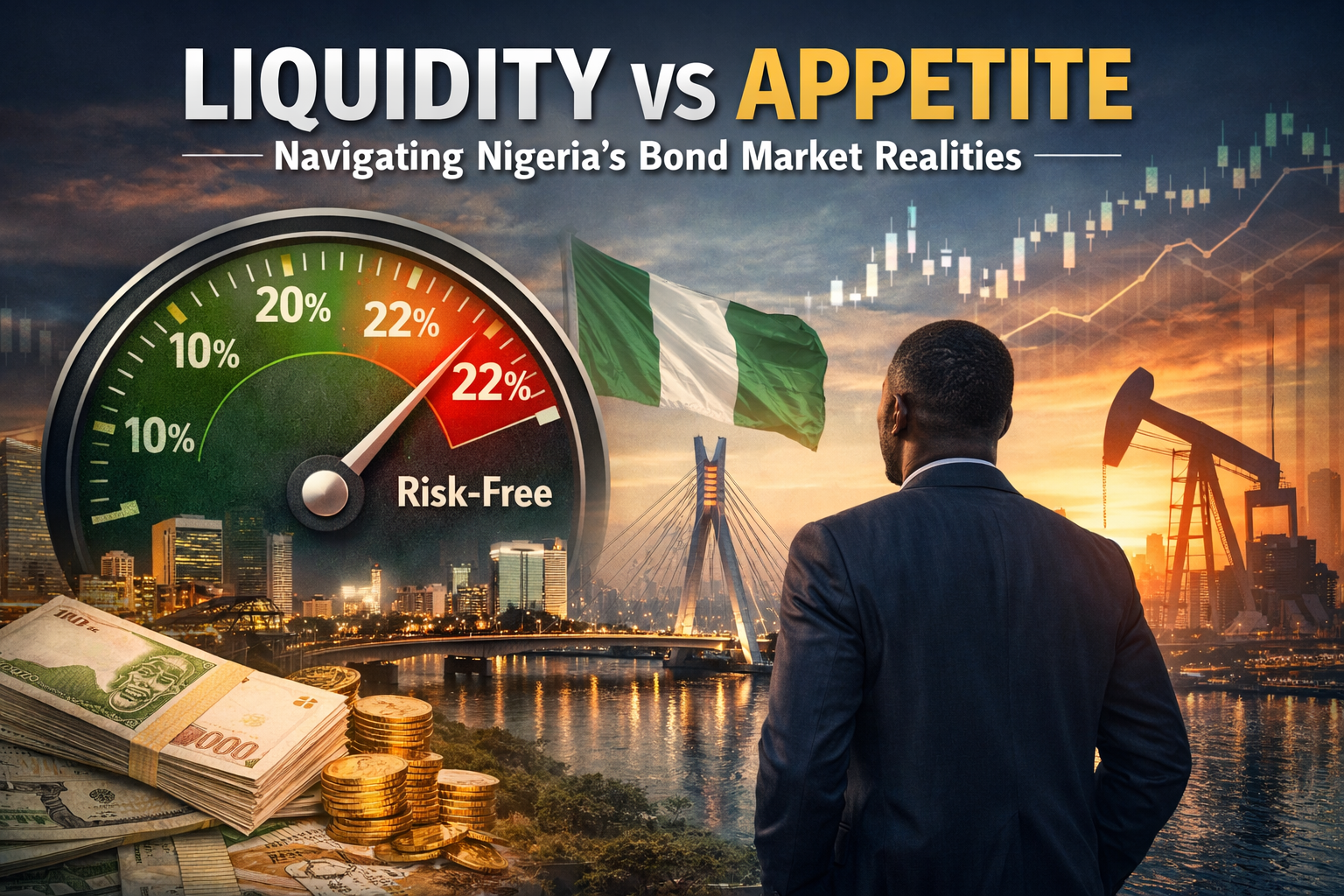

Have you ever wondered why deal activity in Nigeria sometimes progresses more slowly than expected, sometimes fail, even when liquidity appears abundant? The reality is that deals do not fail or falter because of a lack of capital, rather, they stall because it is challenging to align available funds with the appropriate risk, duration, and expected returns. The disconnect lies in the interaction between sovereign debt markets and corporate financing.
The Federal Government, through the Debt Management Office (DMO), recently targeted N900 billion in its January 2026 bond auction. The DMO confirmed that the auction is scheduled for today, 26 January, with settlement on 28 January. While the volumes are substantial (100% increase of same period last year – N450 billion), the yields reveal the more important narrative: the 7-year (2031) bond cleared at 18.5%, the 10-year (2034) at 19.0%, and the 11-year (2035) at 22.6%. These yields reflect the risk premium demanded by investors and establish a benchmark that all corporate borrowers must respect.
At the same time, according to publicly available auction results, the Central Bank of Nigeria (CBN) saw strong demand for Nigerian Treasury Bills of ₦3.44 trillion at the primary auction on Wednesday, 21 January 2026, far exceeding its offer and the highest since December 2024, as investors locked in on high returns. Although this oversubscription indicates confidence in fiscal policy, it also reveals Nigeria’s dependence on domestic borrowing to finance its 2026 budget deficit which, according to Nairametricts, is around N15 trillion (https://bit.ly/4qZjrJP).
Since seeing the headlines, I have found myself asking a simple question: if I were the Managing Director of an investment bank, and the Federal Government is offering over 22% on a risk-free basis, why would I deploy capital elsewhere? Why would I fund startups as a venture capitalist under such conditions? This is not a question of liquidity, funds are available, but of how risk should be priced when weighed against such a compelling opportunity. That question captures the reality many dealmakers in Nigeria face today.
Why does this matter for your next deal? Government securities are like a car speedometer; they signal the economic reality of a country. For investment bankers, private equity sponsors, and valuation professionals, these rates effectively define the risk-free rate. With the 2035 bond yielding 22.6%, corporate borrowers are aware that the road ahead is steep. An investment would need to offer a return above the risk-free rate, likely above 24%, to compensate for credit risk, in addition to any default spreads or country risk premiums. This benchmark clarity is essential as it anchors valuations in market reality, even if it increases the hurdle rates.
Converting sovereign liquidity into private sector growth requires both creativity and patience. While banks may be reluctant to engage in long-term exposures, the oversubscribed T-Bill market demonstrates that asset managers possess considerable “dry powder.” In the M&A space, understanding these sovereign benchmarks is vital for pricing debt-funded acquisitions and determining realistic equity hurdle rates.
However, liquidity alone does not guarantee that deals will not go wrong. Most funds remain committed to short-term instruments, regulatory limits restrict pension fund and insurance companies’ allocations to higher-risk assets, and the attractiveness of sovereign yields tends to crowd out corporate lending. The reality is this: capital is available, but the challenge lies in pricing the risk accurately, and that is precisely where many deals go wrong. Achieving success today requires more than merely identifying a target, it demands deal structures that are consistent with benchmark rates and investor risk appetite. For dealmakers operating in Nigeria, understanding these dynamics is not optional, it is the difference between a successful transaction and those that will fall flat.