admin
admin
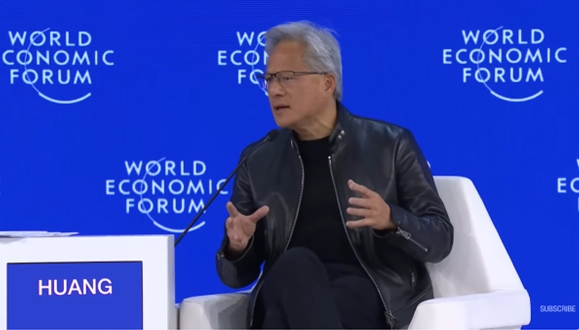
I closely followed the recent World Economic Forum in Davos, with particular attention to technology and geopolitics. One interview that stood out was Jensen Huang’s discussion with Larry Fink. Huang’s message was clear: AI is no longer just software. It is rapidly becoming industrial infrastructure, on a scale comparable to electricity or the internet, with profound implications for investment, energy policy, and global competitiveness.
Huang reframed large language models like Anthropic’s Claude and OpenAI’s ChatGPT not as applications but as platforms, foundations on which industries will be built. Intelligence is emerging as a factor of production, alongside labour, capital, and energy.
This explains Nvidia’s strategy. The company does not aim to “win” the model race. Regardless of which model enterprises adopt, all rely on the same stack: accelerated computing, high-speed networking, and optimised software. Nvidia’s goal is to power the ecosystem, not compete at the model layer.
Energy is central. Modern data centres are “AI factories”, converting electricity into intelligence. The next constraint on AI growth may be power availability, not algorithms or chips, highlighting the importance of physical infrastructure and industrial policy.
Huang outlined six layers of AI, from energy to applications:
1. Energy: The raw material of AI.
2. Compute: GPUs turn energy into intelligence.
3. Networking: High-speed interconnects integrate chips.
4. AI Infrastructure & Systems: Data centres optimised for training and inference.
5. Models: Foundation models like Claude and ChatGPT.
6. Applications: AI deployed in real workflows that create economic value.
My key takeaway from this is that value is distributed across the stack, not concentrated at the model layer.
Reflecting on this, I recall a conversation with a client who leads a global data centre business. They noted Europe’s energy deficits and the strategic advantage of regions with stable, abundant power. For Africa, and Nigeria in particular, this presents an opportunity. Even if we cannot yet compete in AI models or advanced computing, we can leverage the energy sector, the foundational layer of AI infrastructure. Nigeria must urgently and significantly improve and modernise its power sector to secure a place in this rapidly evolving, AI-driven industrial landscape.
In short, as Huang emphasised, AI is no longer just being coded; it is being built, from power plants all the way up to platforms.
Listen to the full interview here: https://lnkd.in/enN2bkWf